
 Business
 This article delves into the realm of Lido DAO and its pivotal role in furnishing liquidity for staked assets. We will explore the operational mechanisms of Lido, its advantages, and the challenges and constraints confronted by project participants. Furthermore, we will contemplate the future prospects and evolution of Lido, comprehending the distinctive contribution this project offers to the decentralized finance landscape.
8 min.
13.07.2026
The ultimate guide to crypto staking basics: tips for beginners
Have you ever wondered what crypto staking is and how it works? In many cases, it can be a little bit difficult to understand this particular concept, leaving many people wondering how this idea works. Still, if this is something that’s been leaving you feeling baffled, don’t worry – this article will outline some of the key things you need to know about crypto staking and what a crypto staking wallet is to help inform your decisions.
What is crypto staking?
Finding a reliable guide that covers crypto staking explained can often seem hard, but if this is something you’ve been wondering about, it’s important to first consider what it actually is.
Cryptocurrency staking occurs when the holder of cryptocurrencies temporarily locks their currency. This activity helps support the stability of the blockchain, keeping things more operationally functional and stable as a result.
With cryptocurrency staking, crypto holders are rewarded for staking their assets by receiving additional cryptocurrency in exchange. This is somewhat similar to how a bank provides a small amount of interest in savings for traditional fiat currency. However, the exact staking rewards you will receive will depend on many factors, such as the amount of crypto you stake, the duration of time for which you stake it, and even the type of cryptocurrency you choose to begin with. Moreover, there is no guarantee you will receive a payout.
Most often, cryptocurrency staking activities provide incentives in the form of a percentage based reward. This reward is generated because the blockchain makes your staked currency work.
Which cryptocurrencies are possible for staking?

One point that surprises many people looking to start their own crypto staking wallet is that not all cryptocurrencies can necessarily be staked. In line with this, if you have been looking to try this, you will first need to check that you initially have the right type of currency in your wallet.
So, what currencies are available for cryptocurrency staking? Well, at present, some of the main cryptocurrencies used for this goal include Ethereum and Tezos, as well as Cardano, Solana, and Cosmos. However, there are potentially others available as well, so it’s important to be careful with this decision to find the right options for your needs.
With that being said, it’s important to recognize that Bitcoin does not allow staking, despite being the biggest cryptocurrency. As such, just because a cryptocurrency is well-regarded and popular is not enough reason alone to assume that staking will be available.
What are the common types of rewards?
At this point, we’ve briefly touched upon the basics of what cryptocurrency staking is and how does crypto staking work? Still, it’s well worth answering before we go any further what the different types of available rewards are.
There are several potential rewards that you can receive from your efforts. However, it’s well worth recognizing here that the rewards you will receive should match the type of currency you originally staked in your crypto staking wallet.
As such, if you staked Ethereum cryptocurrency, you would also receive rewards in Ethereum, and so on. As such, before you choose a crypto staking wallet currency, make sure you’re happy with your choice of currency overall.
Getting started with crypto staking
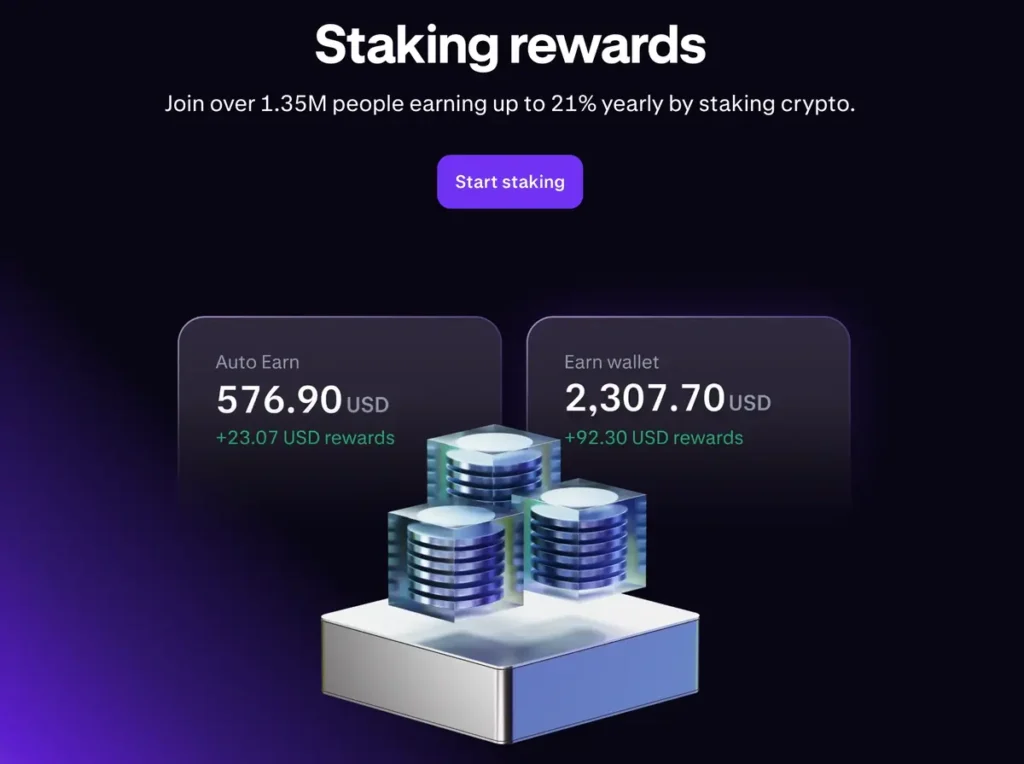
By now, we have looked at crypto staking explained – but we still need to cover how to get started with this for your own trading goals. Luckily, it’s relatively easy to find out how does crypto staking work, so deciding whether this could be a good option for your needs is relatively straightforward.
Choose a currency
In order to get started with cryptocurrency, you’ll naturally need to own a cryptocurrency that can actually be staked. As we mentioned prior, not all crypto options will necessarily accept or offer this, so being aware of this and taking steps to ensure your staking efforts aren’t interrupted are highly important.
Ethereum is still one of the most popular options, so this could definitely be a great option if you’re not sure which type of crypto to stake. However, you should always keep in mind that there is not necessarily a guarantee that you will profit here, even with a big currency like Ethereum.
Purchase currency
Once you have decided which currency you want to use, you can then look at buying the relevant currency and getting it added to your crypto currency wallet. Some cryptocurrency exchanges may offer their own crypto wallets alongside their main services; this could be worth keeping in mind to make life easier when buying and selling cryptocurrency.
Find a staking pool
By now, you’ve chosen a cryptocurrency and have purchased crypto to use in your staking efforts. At this point, you’ll want to begin looking out for a top-rated staking pool to help increase your chances of getting a good reward. Joining a pool increases your chances of getting a reward, so this is a worthwhile step to keep in mind often.
Join the staking pool
So, you’ve stumbled across your choice of staking pool. Now, all you’ve got to do is join the staking pool and actually contribute your funds to the cause. One of the key points here to mention is that the staking pool handles everything for you, so you won’t have to worry so much about ensuring your cryptocurrency is working hard and earning rewards for you!
What to look for from a good staking pool

If you want to ensure that your cryptocurrency efforts are as successful as possible, you’ll need to start with a top-rated pool. Indeed, while many people assume that the staking pool is just a “means to an end,” this isn’t wholly the case. In fact, different staking pools have a wide array of features, and this can significantly influence your success and crypto earning opportunities.
Server uptime
When looking for a cryptocurrency staking pool, you must always look for a pool that has an almost perfect uptime. Indeed, uptime directly influences your ability to earn rewards; if your pool’s servers are down, you won’t be contributing to the blockchain and won’t earn rewards. Accordingly, choosing a server with an excellent uptime score will help keep your stake earning for longer.
Fees
Fees for crypto taking are fairly self-explanatory. Still, when choosing a suitable pool for your efforts, we strongly recommend considering the cost of each pool carefully – as this can really eat into your potential profits with cryptocurrency stakes.
The most common fees taken from your crypto staking wallet will be around 5% or less. As such, when choosing a pool, make sure to consider key points such as cost to determine which pool best suits your needs. These pool fees can significantly influence your success with crypto overall.
Reward vs risk
As a further point, you should strongly consider the difference between reward and risk to help you make an informed decision.
A lower-risk option is to try things out with a large pool. When talking about crypto staking explained, these large groups are much more likely to win. But, of course, the winnings will be split across numerous people, so if you prefer the thrill of potentially winning a higher reward, joining a smaller pool may be better.
How does crypto staking work to earn money?

While many people assume that earning money from crypto staking sounds too good to be true, it is in fact a legit method of making money, although not a get-rich-quick scheme as many people like to portray it as.
Nevertheless, there are many benefits associated with this for the user and blockchain alike. Indeed, this allows the blockchain’s efficiency to be maintained; what’s more, this process is potentially more eco-friendly compared to regular mining.
Moreover, this process does not require specialist equipment and is incredibly easy as an earning opportunity for unused crypto funds. As such, it might be ideal if you have any money left hanging in your crypto wallet and want to begin making money from it. You may then receive a small percentage of your crypto back as a reward.
However, before you invest, make sure you consider the financial implications on cryptocurrency. Indeed, though it’s uncommon, it’s not impossible for cryptocurrency values to fluctuate, meaning you could actually end up with less value by the time your reward has paid out. Fortunately, there are still a couple of wallets that don’t necessarily take quite so long to get your money to you, so this can help reduce the risk of losing value.
Final thoughts
Overall, crypto staking offers a way to earn rewards by supporting blockchain stability. While it’s important to choose the right cryptocurrency and staking pool, there are risks to consider, such as market fluctuations. Nonetheless, with careful planning, crypto staking can be a valuable investment opportunity in the world of cryptocurrencies.
Start your crypto exchange with Coin24


Exchange BTC, ETH, USDT and more — cash or card
Secure and fast crypto exchange since 2018
Buy or sell
100+
cryptocurrencies quickly and easily
Exchange crypto with cash or
card with Coin24
Exchange crypto
online
or in person in 50+ cities
Buy or sell cryptocurrency
via Privat24
Similar Articles

08.06.2022
Staking can be seen as a less resource-intensive and more environmentally friendly alternative to mining. What it consists of, what are its features and whether it is possible to earn on staking – we will tell in this article.