
 Business
 Nxt (NXT) steps onto the stage an innovative cryptocurrency aiming to change the rules of the game. Let's explore the key features and technical aspects that make Nxtcoin a bright prospect in the world of cryptocurrencies and the potential it can offer in this turbulent environment.
12 min.
19.03.2026
Why Binance coin forecasts are of interest to investors
Since its launch in 2017, BNB has gained huge popularity in the global market. It quickly became one of the most valuable and popular cryptocurrencies. With a current market capitalization of over $70 billion, BNB is a dominant player in the cryptocurrency market.In this guide, we’ll take an in-depth look at the world of BNB, exploring its unique features, advantages, use cases, and future prospects.
More about BNB: its role in the Binance ecosystem and beyond
BNB is a digital asset used to pay fees on the Binance platform. BNB holders can receive fee discounts of up to 25%. High fees are always associated with large transactions, so this can lead to significant savings.
Participation in the Binance ecosystem
BNB also provides access to other products and services within the Binance ecosystem, including decentralized finance, exchange platforms, and payment systems.
Limited supply
BNB is a utility token with a limited supply of 200 million. This reduces the risk of inflation and enhances the token’s long-term value.
Support and development
The Binance team actively supports and develops BNB, ensuring the product’s stability and continuous improvement.
BNB applications in DeFi and fintech

Payments and exchange
BNB can be used to pay Binance fees, as well as to exchange for other cryptocurrencies or fiat currencies.
Investing
Thanks to its growth potential and unique advantages, many investors consider BNB an attractive option for long-term investment.
Payment systems
BNB can be integrated into payment systems to simplify and streamline the payment process.
Decentralized finance
BNB can be used in decentralized finance applications to obtain loans, invest, and participate in decentralized offerings.
BNB History, price chart, and current status
BNB was launched in 2017 via an ICO as an ERC-20 token on Ethereum and then migrated to its own network in 2019. The initial supply was 200 million tokens. Following the 34th quarterly burn in January 2026, the circulating supply decreased to approximately 136.36 million BNB. Since the launch of BEP-95, an additional 281,000 BNB have been burned.
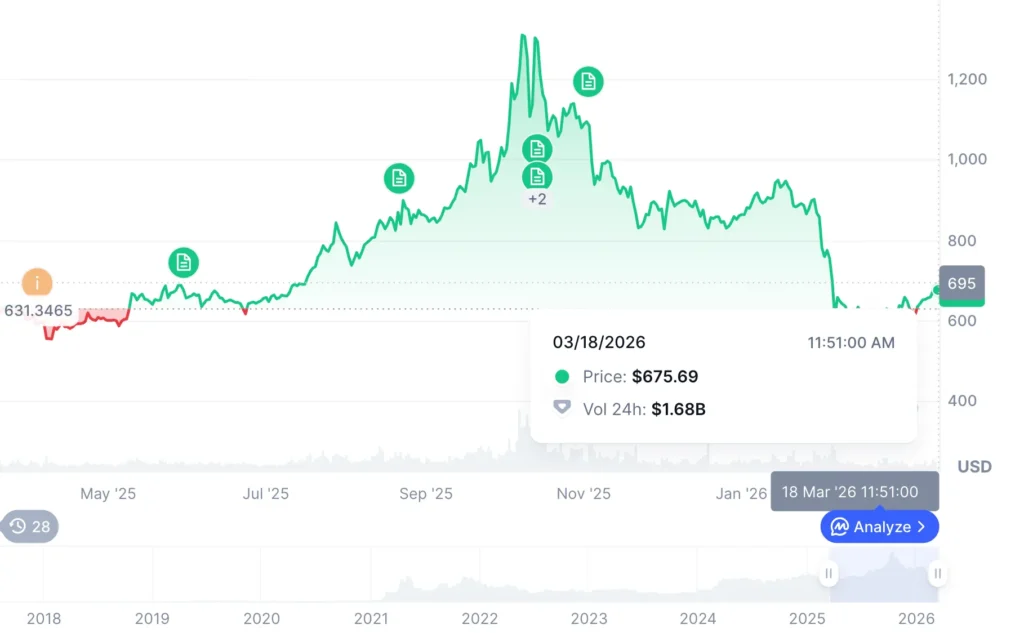
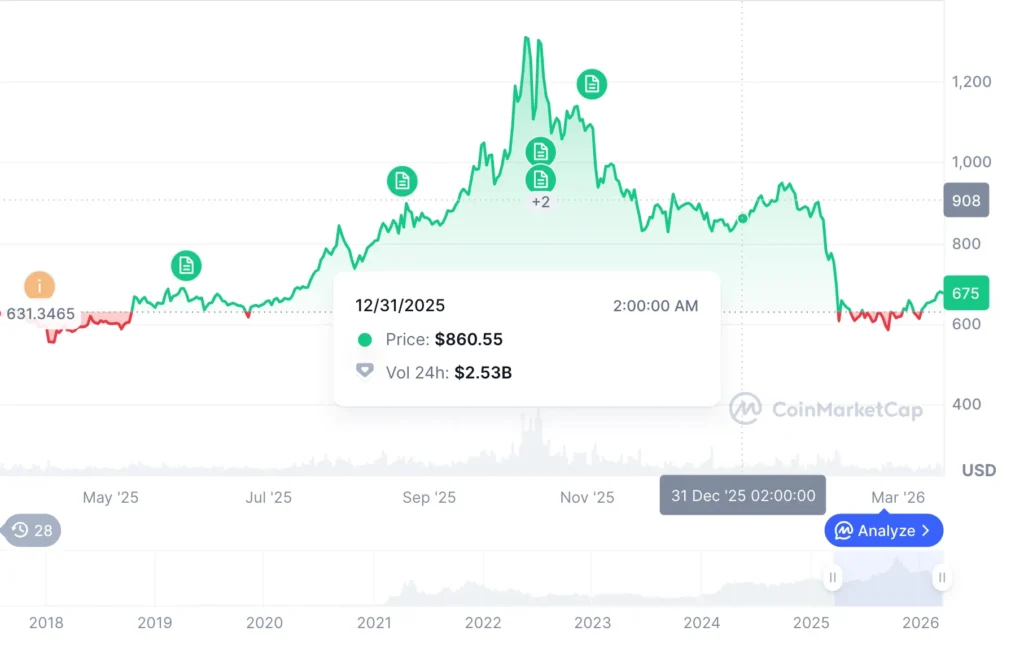
Forecasts for BNB are mixed. It remains one of the largest crypto assets—ranking fifth by market capitalization on CoinMarketCap—and its circulating supply is now close to its maximum. But after reaching an all-time high in the fall of 2025, the price declined. BNB ended 2025 at around $863, and by mid-March 2026, it was trading below that level, at around $675. Even major cryptocurrencies move in cycles, and BNB is no exception.
Fundamental factors influencing the BNB forecast
Development of the Binance ecosystem
As the Binance ecosystem and Binance Chain continue to grow, BNB’s role in payments, investments, and the use of various products and services will become increasingly important.
Integration with other platforms
As the popularity of cryptocurrencies and blockchain grows, BNB may be integrated with other platforms and projects, which will increase its utility and value.
Growing popularity of BNB as a payment tool
As the number of trading pairs and applications supporting BNB increases, its use as a payment method will grow.
Development of decentralized finance
Decentralized finance is one of the fastest-growing sectors of the cryptocurrency market, and BNB can play a key role in this sector thanks to its unique advantages and integration with various decentralized finance applications.
Increased liquidity
As trading volume and the use of BNB in various applications grow, its liquidity will increase, which, in turn, will reduce the risk of market crashes and sharp price movements and increase the token’s value.
Current technical analysis of BNB
If we look at the technical analysis objectively, without taking into account investment recommendations, the outlook for BNB as of mid-March 2026 is mixed. The current price is around $665, while the price range over the past 52 weeks has been around $362-1,375. This means that the market is far from its lows, but also well below its all-time high.
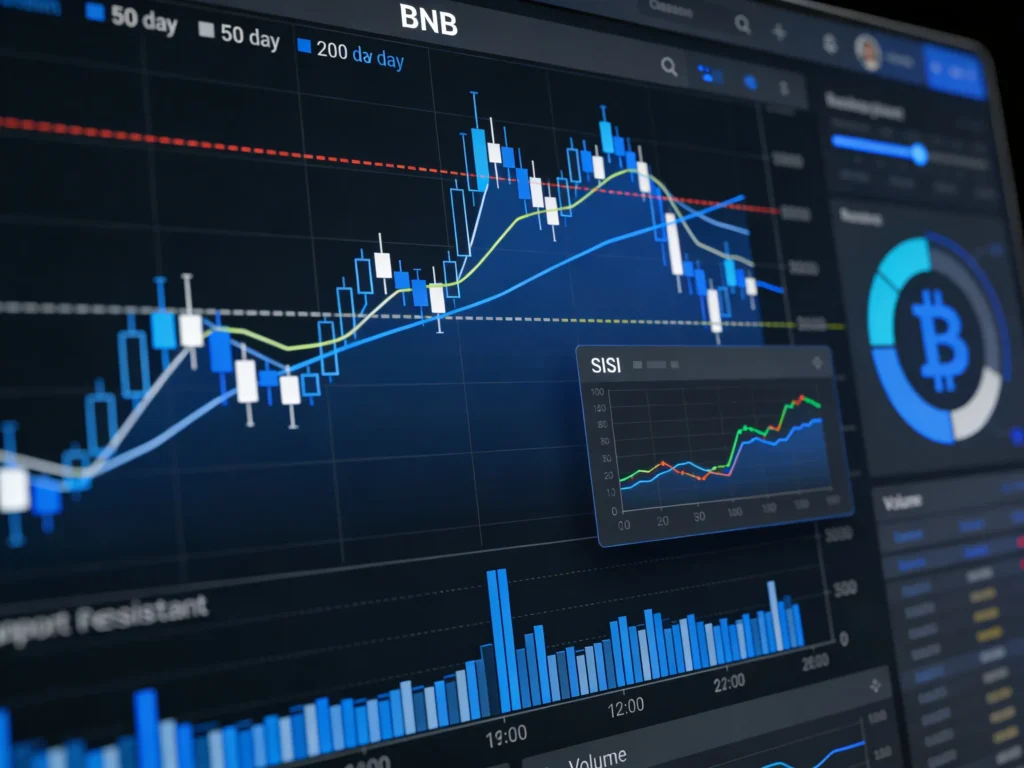
According to Investing’s aggregated technical data, the daily signal for BNB is closer to neutral, but the 14-day RSI is in the 34 range, and the 5-day and 50-day moving averages are slightly above the current price. In other words, the market is no longer in a state of complete collapse, but has not yet confirmed a sustainable recovery.
According to IG, the market sees the range of $666.5-669.6 as the nearest resistance zone, while key support levels are around $621.98 and $609.44. This means one thing: the short-term trend is still transitory, and therefore, the main logic for evaluating the asset for 2030 should not be based on the weekly RSI, but on fundamentals and BNB’s position in the industry.
BNB price forecast for 2026
In fact, in 2025, BNB outperformed even the most conservative market expectations: in the fall, the asset’s price reached a new all-time high of around $1,370; however, a correction occurred in 2025, and by the end of December, BNB was trading at approximately $860. This means that the scenario “BNB could reach new highs thanks to Binance’s strong ecosystem and increased network activity” has already been confirmed by the market in practice.
But another point is equally important: after that, the market also demonstrated the flip side of the coin. According to Binance Research’s 2025 price forecast for Binance Coin, BNB fell by 28.4% in February 2026 alone amid a general risk-averse sentiment in the cryptocurrency market, while the total market capitalization declined by 22.6% over the month. In other words, even a successful 2025 did not eliminate high volatility. For an investor planning to invest in Binance Coin in 2026, this is a valuable lesson: BNB’s past growth does not in itself guarantee further upward movement.
BNB price forecast for 2030
It is impossible to accurately predict the price of BNB for 2030, so it is more accurate to talk about scenarios rather than a “magic number.”
In a pessimistic scenario, BNB could remain within a wide range until 2030—potentially rising to around $600–$800. This is possible if Binance loses market share, Binance Smart Chain falls behind competitors in terms of developer numbers and liquidity, and the token’s utility proves insufficient to offset regulatory and industry risks. This scenario does not imply a collapse of the ecosystem, but indicates that BNB will remain an important asset with a history of growth, albeit not a market leader. This forecast is based on the token’s current dependence on the strength of the Binance ecosystem, L1/L2 competition, and the market’s high cyclicality.
In the base case scenario, the price of BNB could reach $900–$1,600 by 2030. This is also not a market consensus forecast, but a scenario model. It assumes that BNB will maintain its status as a top-tier asset, the burn mechanism will continue to reduce supply, BNB Chain will remain among the most widely used networks, and Binance will support the token’s utility through its products. In this case, the market could at least periodically drive BNB to historical highs and beyond.
Under the optimistic scenario, the price of BNB could reach the $1,800–$3,000 range by 2030. This requires not only overall growth in the crypto market but also the convergence of several factors: sustained demand for BNB as a utility asset, expanded access for institutional investors, the execution of the network’s technical roadmap, growth in the DeFi/RWA/AI sectors within the BNB Chain, and the maintenance of Binance’s strong position in the global industry. This is the most aggressive scenario, and it depends not so much on a single bull run as on whether BNB can remain a key infrastructure asset rather than just an “exchange token.”
BNB’s outlook compared to competitors
When comparing BNB to Ethereum, the difference lies in the fact that ETH remains a more neutral foundational infrastructure for smart contracts and significantly outpaces BNB in market capitalization: approximately $280 billion versus approximately $91 billion for BNB. Ethereum has an advantage in institutional recognition and significant economies of scale. BNB’s strengths lie in its tighter integration with the exchange’s ecosystem and a clearer utility model for Binance users.
The comparison with Solana is different. SOL currently has a smaller market capitalization, around $53.6 billion, but higher DEX activity according to DeFiLlama: approximately $2.88 billion in daily DEX volume versus roughly $1.15 billion for BSC. This makes Solana a strong competitor in the on-chain retail traffic segment and in the “app-first” narrative. Meanwhile, BNB counters not only with speed and low fees but also with the fact that demand for it is supported by the entire Binance product ecosystem.
The competition with TRX is even more interesting. TRON looks very strong in the stablecoin and payments sectors: the network has a stablecoin market capitalization of about $86.8 billion and approximately 2.91 million active addresses per day. BSC’s stablecoin market capitalization is significantly lower—around $14.25 billion—and it has about 2.52 million active addresses, but the BNB chain is broader in terms of DeFi, dApps, and exchange-related utility. Simply put, TRX is stronger as a payment channel, while BNB is a more versatile option for the Binance ecosystem and its network of applications.
Key risks to BNB’s long-term outlook
The main risk is concentration. BNB is closely tied to Binance, which is both its strength and its weakness. As long as the exchange, its products, and the ecosystem’s infrastructure remain stable, the token benefits from additional demand. But if the regulatory environment deteriorates again or Binance begins to lose ground, this will hit BNB harder than more “neutral” network assets. Even if the SEC case is closed in 2025, the underlying factor of regulatory dependence will not disappear.
The second risk is competition. Ethereum, Solana, TRON, as well as new L1/L2 platforms, are constantly competing for developers, capital, and users. For BNB’s price, it is important not only to remain a “major project” but also to maintain real on-chain activity, liquidity, and appeal to developers.
The third risk is cyclicality. Historical data on the BNB price has already shown that the asset can experience sharp upward movements followed by deep corrections. Therefore, any long-term forecast for the Binance Coin price must take into account not only fundamental indicators but also market phases, liquidity, and macroeconomic conditions.
Should BNB be considered a long-term asset through 2030?
From a neutral analytical perspective, the answer is this: BNB can be considered a long-term asset only for those investors who consciously accept its hybrid nature. This is not a “pure bet” on any single theme. It is simultaneously a bet on the exchange, the BNB network, the tokenomics with burning, DeFi, and Binance’s ability to adapt to the regulatory and competitive environment.
BNB has compelling arguments in favor of long-term investment: historically high utility, a deflationary mechanism, a large-scale ecosystem, a technological roadmap, and already noticeable signs of institutional adoption. But there are also reasons for caution: dependence on the Binance brand, competition from ETH, SOL, and TRX, as well as high price volatility even after strong years. Therefore, BNB is more of an asset for scenario analysis and risk discipline than a story that can be predicted based on a single attractive figure for 2030.
What influences the price of BNB in the long term
In the long term, five factors most influence BNB price forecasts: Binance’s market position, actual activity on the BNB chain, the volume of utility within the ecosystem, the rate of supply reduction through burning, and the overall state of the crypto market. If at least three of these factors are moving in the right direction simultaneously, BNB gains a solid foundation for growth. However, if the ecosystem, regulatory environment, and on-chain metrics begin to deteriorate, the burning mechanism alone will not save the market.
The Future of BNB: final conclusions

BNB is a cryptocurrency that has successfully established itself in the crypto market since its launch in 2017. In recent years, BNB has also strengthened Binance’s position as one of the largest ecosystems in the digital assets space. This is precisely why BNB remains one of the most popular utility tokens: its advantages, wide range of use cases, and connection to the Binance ecosystem directly influence user and investor interest. Binance’s success, the development of the BNB Chain, the expansion of the token’s use cases, and integration with other platforms—all these factors could influence the asset’s price in the long term. If we were to answer the question of why BNB continues to attract significant market interest, the reason lies in its practical utility, robust infrastructure, and sustained demand within the ecosystem.
It is impossible to pinpoint a single figure for the projected price of BNB by 2030. Binance Coin has already proven capable of reaching new all-time highs, only to quickly lose tens of percent during corrections. Today, the price of BNB is one of the key benchmarks for market participants, but the current price alone does not provide a complete answer regarding the asset’s future. It is important to consider fundamental factors, historical data, price trends, technical indicators, as well as how BNB reacts to changes in demand and the overall dynamics of the cryptocurrency sector throughout market cycles. BNB could demonstrate significant growth again if the ecosystem continues to develop; however, the future price of BNB will still depend not only on the overall bullish momentum but also on the actual value of the network and the token itself.
Looking ahead to 2030 without the hype and financial promises, BNB remains one of the few major tokens with a proven track record, utility, and infrastructure. The asset’s strengths include its real-world utility within Binance and the BNB Chain, its deflationary model, and the scale of its ecosystem. Weaknesses include dependence on a single major brand and constant competition for users, liquidity, and developer attention. Therefore, assessing the token’s price in the long term requires a comprehensive approach: evaluating the state of the ecosystem, Binance’s market position, the level of network activity, and the project’s ability to adapt to new conditions. It is precisely this, and not just optimistic forecasts for 2026, 2027, 2030, 2040, or 2050, that will determine whether BNB can maintain its strength and continue to grow in the coming years.
Frequently asked questions about the forecast usually boil down to one thing: can BNB continue to grow? The answer remains neutral—yes, but only provided that the key factors capable of influencing the price continue to work in favor of the Binance ecosystem.
.
Start your crypto exchange with Coin24


Exchange BTC, ETH, USDT and more — cash or card
Secure and fast crypto exchange since 2018
Buy or sell
100+
cryptocurrencies quickly and easily
Exchange crypto with cash or
card with Coin24
Exchange crypto
online
or in person in 50+ cities
Buy or sell cryptocurrency
via Privat24
Similar Articles


18.10.2023
In this article, we will look at what an NFT is in simple words, how to create your own token, and tell you about the most promising NFT projects for investment.

12.09.2023
Blockchain represents an incomparable technological revolution that is rewriting the rules of data storage and security. Its roots are in the idea of a decentralized database, which provides a new paradigm in information management, distinct from legacy centralized systems.