
 Business
 Fibonacci levels are a well-known and widely used technical analysis tool. However, not every trader knows how to use them correctly. Even experienced traders make serious mistakes when using Fibonacci levels. Some traders doubt that this indicator reflects the state of the market.
9 min.
16.01.2026
Fundamental analysis in cryptocurrency trading
According to the latest data from CoinMarketCap, there are more than 30 million cryptocurrencies in the world, and as we can see from the chart, their number is growing exponentially.
It is expected that by 2030, the market capitalization of the cryptocurrency market will reach $4.94 billion, if the average annual growth rate is 12.8%. And these are quite realistic figures.
New technologies, blockchains, and Layer-2 solutions open up endless possibilities for creating cryptocurrencies. That is why it is so important to be able to understand which ones are truly valuable and significant. Fundamental analysis will help you with this.
What is fundamental analysis of cryptocurrencies
Fundamental analysis of cryptocurrencies is a method used to analyze and evaluate the intrinsic value of an asset, its prospects, and whether it is overvalued or undervalued.
Fundamental analysis of cryptocurrencies is designed to show the ratio of the market price of an asset to its real value. Thus, by determining the intrinsic value, you can assess the speculative nature of the asset and the possible investment risks.
The basics of fundamental analysis of cryptocurrencies:
- the value of an asset tends to change under the influence of certain factors
- these factors can always be identified through a detailed analysis of a particular cryptocurrency
- the long-term trend can be determined by forecasting all the important trends for a given cryptocurrency
Fundamental analysis of the stock market takes into account more traditional factors that can determine the actual value of a company.
This concept first appeared in the 1934 book Security Analysis. The book states that investors should consider all fundamental aspects and analyze stocks before investing in securities. The same applies to cryptocurrencies.
Fundamental analysis and technical analysis: key differences
Although both technical and fundamental market analysis aim to determine future price movements based on historical data, there are significant differences between them.
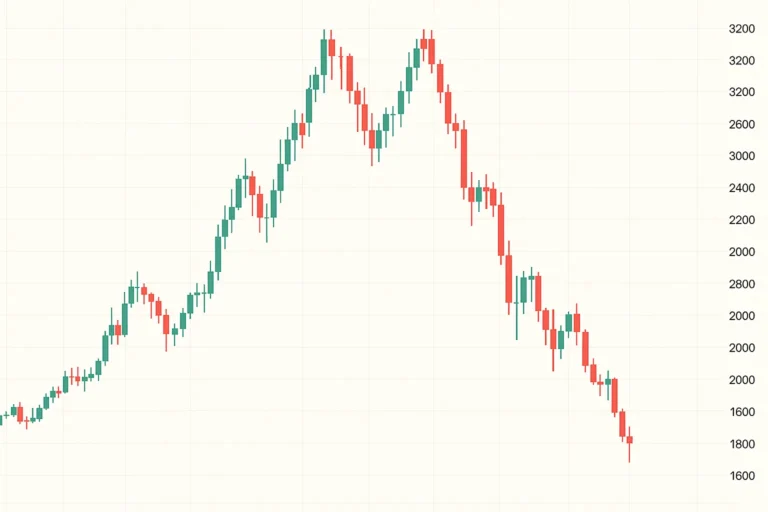
Technical analysis is based on the analysis of historical prices and trading volumes using charts and technical indicators. This allows for very accurate predictions of short-term and long-term price movements. Technical analysis takes into account chart indicators,Fibonacci levels,double tops, and other patterns that allow traders to recognize a reversal or weakening trend in a timely manner.
Fundamental analysis of cryptocurrencies, on the other hand, delves deeper into the project, analyzing design, on-chain, and financial metrics. Everything is taken into account here, from the project team and white paper to market capitalization and hash rate. As the crypto industry develops, more and more new asset valuation metrics are emerging, allowing for more accurate predictions of its future position. Therefore, fundamental analysis is a must for all traders who do not want to lose money on questionable investments.
How to conduct fundamental analysis correctly: key factors for evaluating a crypto project
There are three main types of metrics for fundamental analysis of cryptocurrencies. These are:
- On-chain metrics
- Project metrics
- Financial metrics
Each of these types is equally important for assessing potential prospects, so it is worth considering all indicators if you want to see the full picture.
Let’s look at fundamental analysis using the example of the cryptocurrency XRP.
On-chain metrics
Transactions for each cryptocurrency in the world can be viewed using a public registry that records all actions on a particular blockchain throughout its history. Such open financial data allows you to clearly assess the utility value of a cryptocurrency, its real demand, and user acceptance, as everything is documented.
Among the main on-chain metrics, three are usually highlighted:
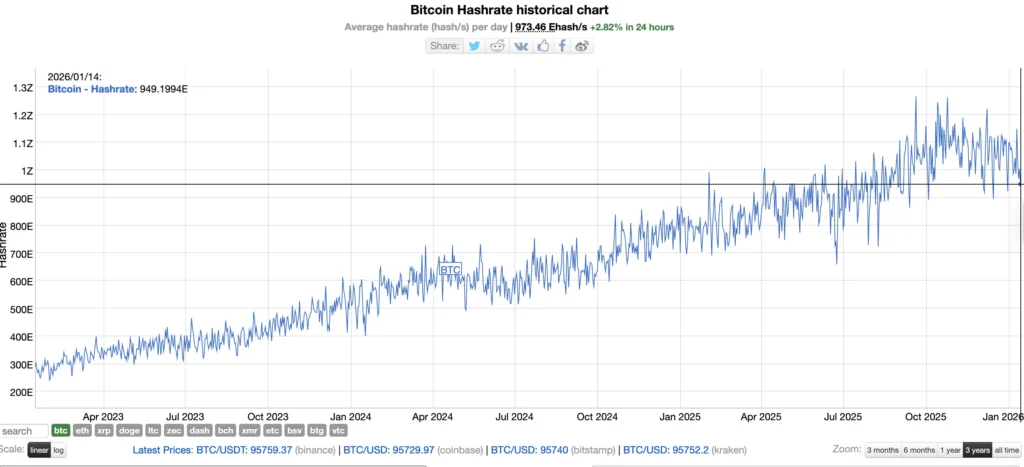
Hash rate: this is the total computing power of the blockchain network, based on the proof-of-work (PoW) consensus mechanism. In such a system, miners are responsible for verifying transactions and performing encryption. For example, the Bitcoin network currently has a hash rate of 975.36 Ehash/s. XRP has a fundamentally different consensus mechanism than Ethereum, so we will not discuss this coin here.
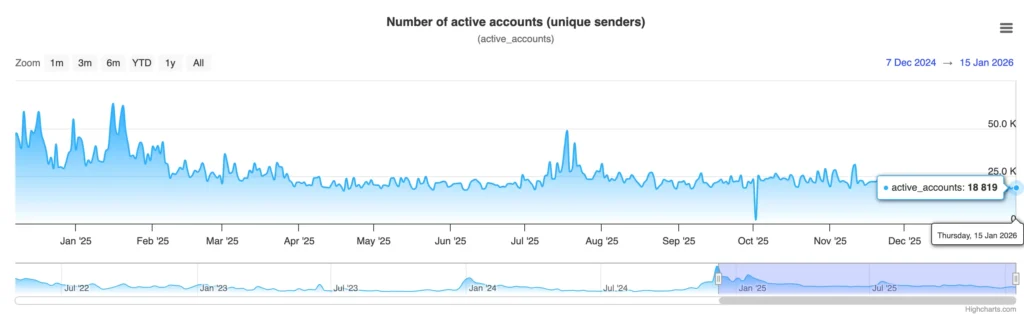
Active addresses: this is the number of unique blockchain addresses that carry out transactions on a given day. This indicator is most often determined by counting the senders and recipients of each transaction over a certain period of time. The more active addresses there are, the more promising and popular the currency is.
Currently, XRP has over 18K active addresses (data valid as of January 15, 2026).
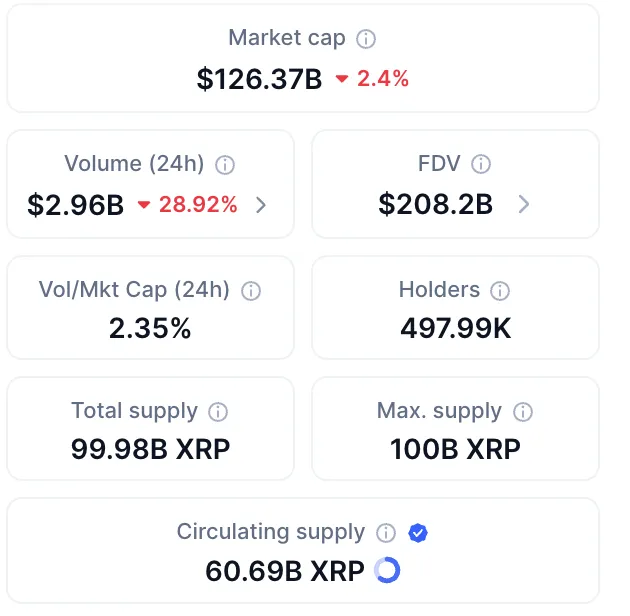
Transaction volume: A high transaction volume means that the cryptocurrency is in constant active circulation and is preferred by traders. Transaction fees can also be interpreted as an important indicator, because the higher they are, the higher the competition for priority in processing transactions.
XRP’s transaction volume is impressive — nearly $3 billion in 24 hours.
Project metrics
Project metrics cover everything related to the project team, white paper, roadmap, detailed competitor analysis, and so on.
Team and partnerships
The project team is its engine, the driving force that can work wonders. The success of any project depends on the competence, experience, and luck of its key players. As a rule, all information about the members of the crypto project development team is available on the website. Check how competent the team members are and whether they have had relevant experience in launching projects before, what achievements and breakthroughs they have made.
Before joining the Ripple project, the entire C-level of XRP had already made a name for themselves in successful projects. Project co-founder Jed McCaleb founded one of the first Bitcoin network exchanges in 2010 (BTC) exchange in 2010. Another co-founder, Chris Larsen, co-founded the online mortgage lender e-Loan in 1996.
Whitepaper and roadmap
The whitepaper is the project’s bible and the main litmus test of reliability for any investor, especially in the DeFi space. This document describes the main goals for which the project/coin and technology were created.
The Bitcoin whitepaper is still the benchmark for this type of document, as it provides comprehensive answers about the nature of blockchain and the goals of its creation. However, the Ripple whitepaper is also a technologically sound document with strong mathematical analysis.
Tokenomics
The distribution scheme of a cryptocurrency can have a significant impact on its price and future. Tokenomics usually balances between several groups of stakeholders. Typically, it is a control scheme with limited supply and coin burning mechanics to regulate its value.
XRP is the native token of XRPL with a fixed supply of 100 billion; no new coins are mined. Network fees are not distributed to validators but are burned, causing the XRP supply to decrease very slowly over time. A significant portion of the issuance has historically been controlled by Ripple, and for sales predictability, the company holds large volumes in escrow with gradual scheduled releases.
Financial metrics
Financial metrics are the economic factors of a cryptocurrency that must be considered when analyzing the potential of a particular coin.
Market capitalization and trading volume
This indicator also directly affects the price of a cryptocurrency. Market capitalization is the total value of all coins that have been mined.
This is the total market value of the cryptocurrency in circulation. This indicator is similar to the capitalization of freely traded shares on the stock market.
Market capitalization = current price x amount of cryptocurrency in circulation.
Tokens with a high market value are often the most stable.
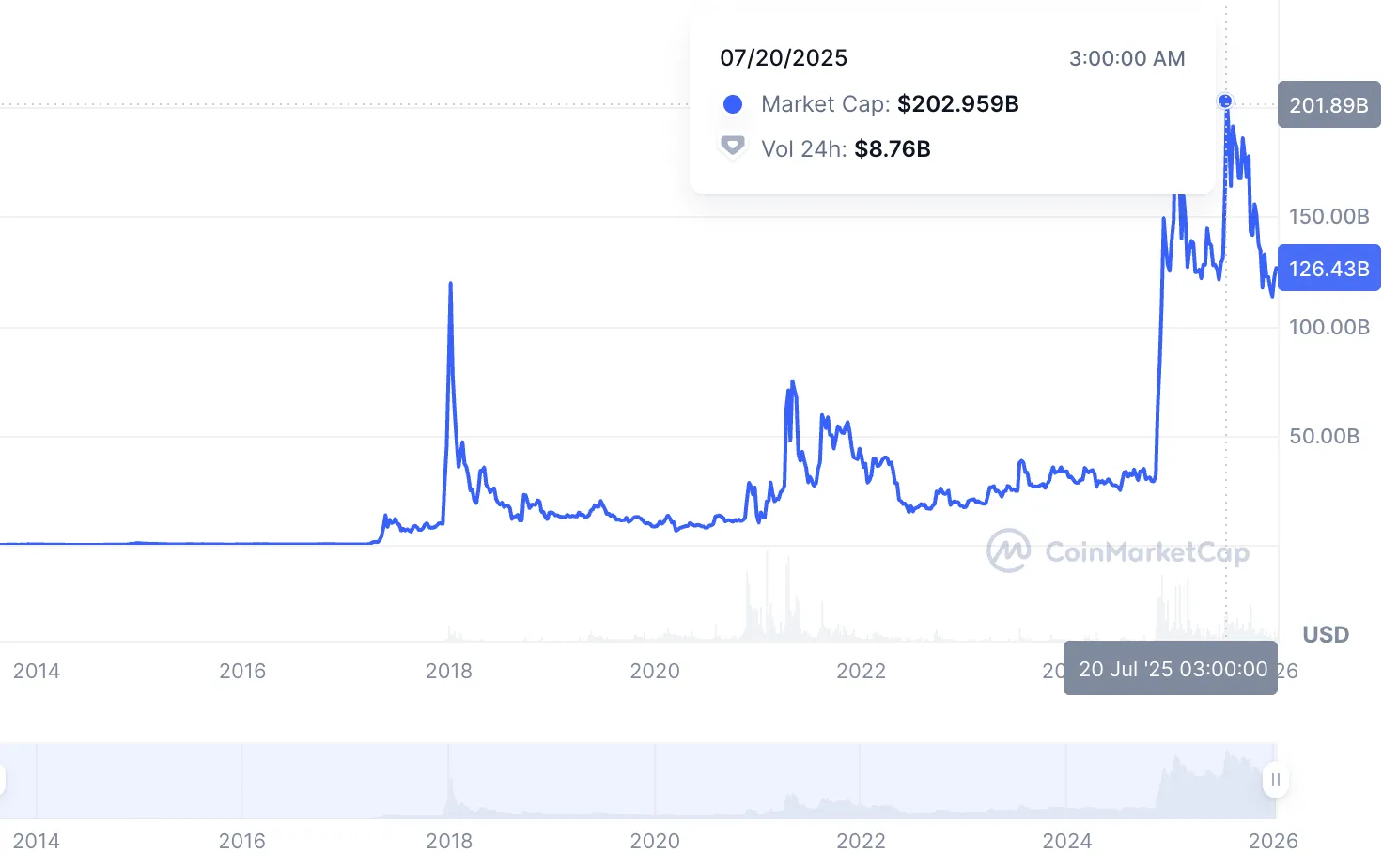
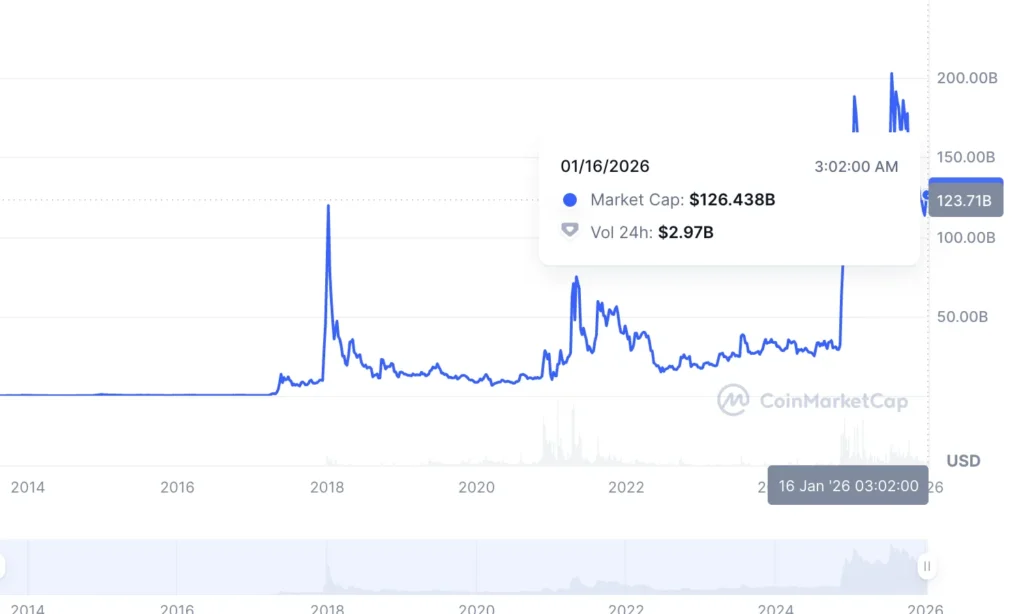
If we look at the XRP market capitalization chart, we can see that the indicator is trending upward, updating another ATH. The latest ATH, $202 billion, was reached on July 20, 2025.
Liquidity and trading volume
Liquidity is an indicator of how easily and quickly a coin can be exchanged for cash or other coins. Low liquidity usually signals high market volatility and vice versa.
The faster buy and sell orders are executed, the easier it is to buy or sell digital assets on the cryptocurrency market.
The main indicator of liquidity is the spread — the difference between the best selling price (ask) and the best buying price (bid) in the order book.
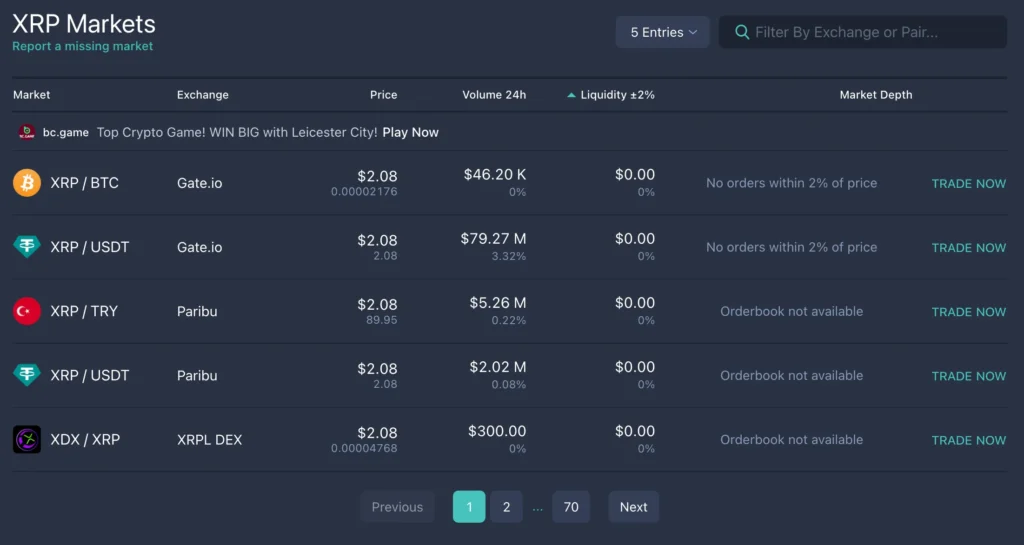
XRP has a consistently high trading volume — the currency is traded on hundreds of platforms.
Fundamental analysis tools (CoinMarketCap, CoinGecko, Glassnode)
No fundamental analysis can do without platforms that help to quickly and effectively evaluate a project and its prospects. The tools for fundamental analysis of cryptocurrencies that can be used to achieve an accurate assessment of a project are:
CoinMarketCap and CoinGecko — these are the “project passport”: supply (circulating/total/max), FDV, volumes, liquidity, spreads, exchanges, and pairs. Here you can spot basic red flags: thin glass, strange volumes, overheated valuation.
CoinGecko is often more convenient when you need to quickly check tokenomics, markets, and “liveliness” (community/dev—trail).
Glassnode is a platform that is less about price and more about money behavior: inflows/outflows to exchanges, LTH/STH, realized capitalization, overheating metrics (MVRV, SOPR).
When conducting fundamental analysis, it is worth using as many tools as possible to get the full picture.
Short-term trading
In short-term trading, fundamental analysis helps to find signals that can quickly affect the price:
Activity on exchanges: a sharp increase in volume or the inflow/outflow of coins to exchanges signals a short-term surge in demand/supply.
Events and news: major announcements (partnerships, new listings, network updates) often trigger short-term price spikes.
Tokenomics: upcoming unlocks, burns, or additional token issuance temporarily disrupt the balance of supply and demand.
Long-term trading
Long-term investors analyze indicators that reflect the fundamental value of a project:
Developer activity: Regular code updates and high team engagement indicate the long-term viability of a project.
Adoption and usage: growth in the number of users, transactions, and integrations demonstrates the expansion of real-world applications for the cryptocurrency.
Holders: an increase in the share of long-term holders (“hodlers”) and a balanced distribution of coins indicate investor confidence.
Realized capitalization: the total value of all coins at the price of the last movement; comparing this indicator with market capitalization reveals the undervaluation of the asset.
Should you trust only fundamental analysis?
Definitely not. Fundamental analysis is just one way to assess the longevity and investment attractiveness of an asset. However, together with technical analysis and other methods of assessing the real value of cryptocurrency, you can get a complete picture of whether to trust a particular asset and invest in it. Do your own research, analyze charts, hire a specialist if necessary — then your investment will be justified and the risks minimized.
Start your crypto exchange with Coin24


Exchange BTC, ETH, USDT and more — cash or card
Secure and fast crypto exchange since 2018
Buy or sell
100+
cryptocurrencies quickly and easily
Exchange crypto with cash or
card with Coin24
Exchange crypto
online
or in person in 50+ cities
Buy or sell cryptocurrency
via Privat24
Similar Articles


15.12.2025
Day trading (day trading) is intraday trading, when all positions on a selected asset are opened and closed within a single trading day. A day trader does not carry trades overnight: each trade lasts from a few minutes to several hours, and by the end of the trading day, the position is completely closed.
31.10.2025
Technical analysis offers a variety of patterns that assist traders in recognizing trend reversals or weakening trends in a timely manner. Seeing such a pattern in time and taking the right action is the key to success in any financial market, including cryptocurrency.