
 Business
 According to the latest data from CoinMarketCap, there are more than 30 million cryptocurrencies in the world, and as we can see from the chart, their number is growing exponentially.

12 min.
15.10.2025
What is Swing Trading – Strategies and Trading Examples
If you like to find the golden mean in everything, swing trading will become your favorite strategy. Swing trading offers the greatest advantage.
You can take advantage of large movements that last several days/weeks. Focus on a few leading stocks and make 1-2 trades per day. Relax and let the market do its work.
What is swing trading?
Swing trading is a trading strategy in which trades remain open for several days to several weeks with the aim of profiting from short-term price fluctuations in the market. To make a profit, swing traders primarily focus on technical analysis and price dynamics. Their goal is to “catch” price fluctuations (hence the name of the strategy).
This trading style is a way to get the market to dance, to catch the rhythm of its fluctuations and succeed. The most important thing here is to buy an asset at local lows and sell it at local highs of the current market wave. Swing strategies are often used when trading on Forex and other classic platforms.
Swing trading strategies are the golden mean between day trading and long-term investing. Unlike other styles, there are far fewer trades and no attempt to close positions on the same day. However, swing trading is not as passive as a buy-and-hold strategy: traders remain active, regularly analyzing the market. This is an excellent trading strategy for those who cannot follow the charts throughout the day and want to earn medium-term income from price fluctuations.
As a rule, the key entry points are the end of a price pullback (correction) and the resumption of movement in the direction of the main trend.
Swing trading strategies

Following the trend
The most basic swing trading strategy is to trade in the direction of the global trend. If a steady uptrend indicator is visible on a higher timeframe, a swing trader will start looking for opportunities to buy on a pullback within that trend. And vice versa. Example: if BTC has been rising for a couple of days, a trader can open a long position (buy) and “swing” on this trend, planning to sell when the growth weakens or reverses.
Trading from support and resistance levels
This swing trading strategy is possible when the price of an asset is moving within a certain range or trend and there are recognizable support and resistance levels. For example, if Ethereum (ETH) fluctuates in the $1,500–$1,600 range for a long time and then breaks through the $1,600 resistance level, this is considered an entry signal.
Trading on breakouts
A breakout is when the price breaks out of a consolidation zone, range, or technical analysis pattern. Here, it is important to watch closely when it breaks out at an important level. Breakouts are often accompanied by an increase in trading volume and can lead to impulsive movements. Example: an asset has been trading in a sideways trend for a long time and then suddenly breaks out of the range — this situation signals the start of a new short-term trend. An experienced swing trader, noticing a confident breakout (for example, BTC rising above the previous price high), can open a trade in the direction of the breakout and hold the position for several days until the momentum slows down.
Moving average crossover
This is a more indicative trading strategy based on technical indicator signals. Two moving averages with different periods are often used. A “golden cross” is a signal when the short-term average (e.g., 50-day) crosses the long-term average (200-day) from below; indicating a possible start of an upward movement (a buy signal). The opposite crossover, the “dead cross,” warns of a downward reversal and serves as a sell signal. Example: if the 50-day moving average for (ADA) crosses the 200-day moving average from below, a swing trader may open a long position, expecting further growth. Similarly, a downward crossover may trigger the opening of a short position.
Retracements (corrections) within a trend
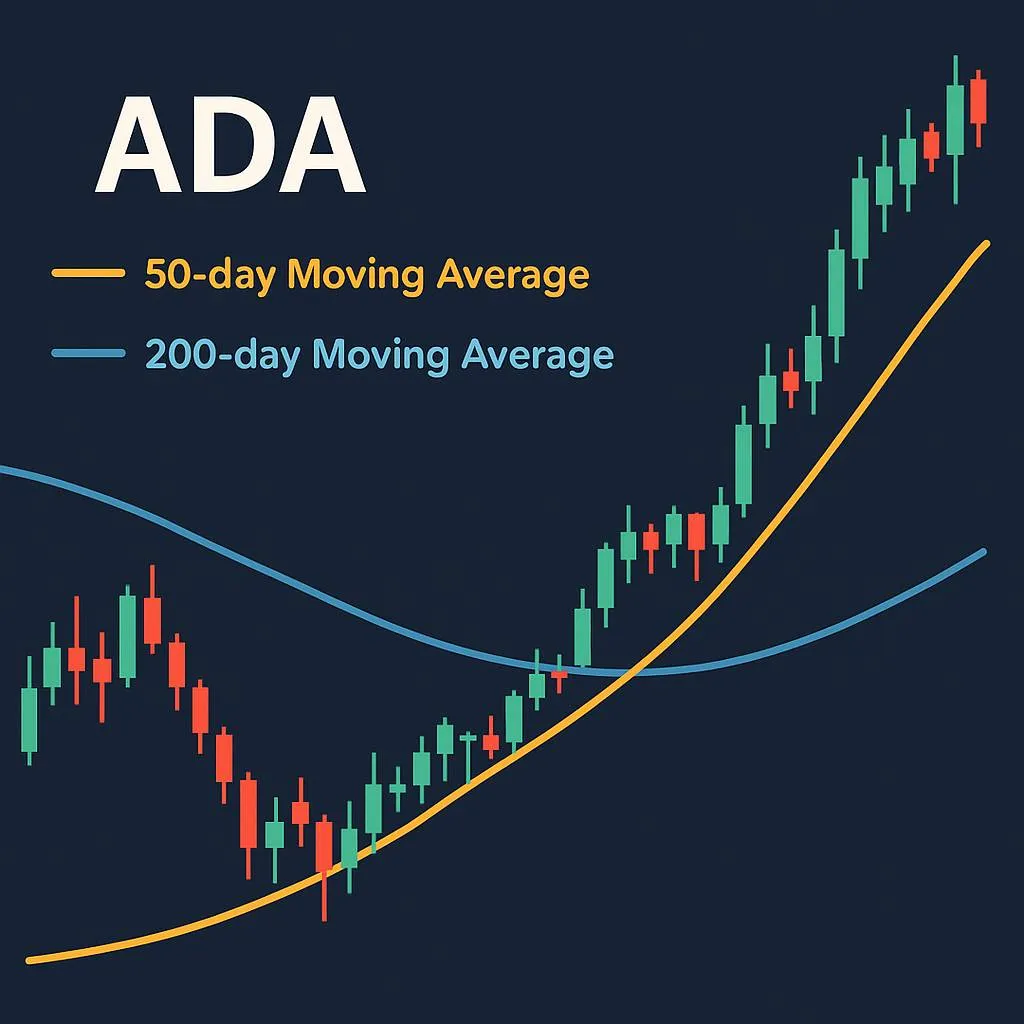
In a strong trend, prices do not rise or fall in a straight line — they are subject to intermediate corrections. The strategy is to enter the market after a pullback. In an uptrend, the trader waits for the price to fall to the nearest support level and starts trading/buying when it resumes its growth. In a downtrend, the opposite is true: wait for a pullback to resistance and sell (open a short position) when the decline resumes. This approach allows you to enter the market at a more favorable price within the trend than if you were chasing the market.
Swing trading strategies: practical examples

Let’s assume that Bitcoin is in a strong uptrend. The price of BTC has been updating local highs for several days in a row with minor pullbacks. A swing trader identifies the nearest support level — say, the previous local low of $30,000 — and waits for the price to pull back to that level.
When Bitcoin remains above support and there are signs of renewed growth (e.g., a bullish candlestick pattern or a rebound from the 50-day moving average), the trader opens a long position around $30,000. The exit point is planned near the next significant resistance level — say, around $33,000–$35,000, where growth has previously slowed. Thus, the trader buys on the pullback and sells on the next price increase, realizing profits from fluctuations within the global trend.
Tools for trading and analysis in swing trading
A successful swing trader relies on a set of market analysis tools that allow them to find these specific entry and exit points. Fundamental analysis includes:
Technical analysis of charts
Reading price charts is a fundamental skill for a swing trader. It is necessary to be able to trade, identify trends, draw their lines, recognize price patterns (reversal or continuation patterns) and candlestick patterns. For example, to understand the big picture and see what trend is emerging, swing traders often look at the daily chart (or 4-hour chart) to determine the trend, and then switch to smaller time frames (hourly, 15-minute) to more accurately determine the entry point.
Support and resistance levels
Identifying key price levels is one of the most important skills that helps traders make money. A support level is a price level at which demand exceeds supply and the price decline stops (“finds support”). A resistance level is the opposite situation, where price growth hits a supply ceiling and slows down or reverses. In swing trading, trades are often made at these levels: a price reversal from the support level signals a buy, and an approach to strong resistance is a reason to take profits or open a short position.
Technical indicators
Indicators are widely used to confirm signals, price movements, and find entry/exit points in the market. Oscillators (e.g., RSI, Stochastic) help assess the state of an asset — whether it is overbought or oversold. RSI values above 70 usually indicate an overheated market (a downward reversal is possible), while values below 30 indicate oversold conditions (an upward rebound is possible). Thus, when the RSI rises from below 30, it is a potential buy signal, and when the RSI falls from above 70, it is a sell signal (profit-taking).
Trend indicators
Moving averages (MA) and MACD show the direction of the trend and moments of its change. The intersection of moving averages or the intersection of MACD signal lines may indicate a change in the market phase and give a swing trader a signal to act. Volatility indicators (such as Bollinger Bands) help to assess the range of price fluctuations: when the price moves outside the Bollinger Bands, this often indicates the beginning of a strong movement or, conversely, an extreme, after which a correction is likely.
Volumes and volume indicators
Trading volume analysis is an important addition. A sharp jump in volume when breaking through a level indicates the strength of the movement and increases confidence in the signal. Conversely, if the price has formally broken through the level but volumes are low, the movement may turn out to be false. Swing traders monitor volumes and indicators such as OBV (On-Balance Volume) to understand whether the volume confirms the observed price fluctuation.
Fundamental factors and news
Market psychology plays an important role: positive news (such as the launch of a Bitcoin ETF or large investments in Ethereum) can cause prices to rise for several days, providing a successful upward swing. Negative news (hacks, bans, statements from regulators), on the other hand, leads to a decline. Therefore, an experienced swing trader keeps their finger on the pulse of the news, monitors sentiment in the community, and assesses how fundamental events may affect the short-term trend.
The choice of timeframe and analysis tools depends on the trader’s preferences. Many swing strategies use a combination of daily charts (for the general trend) and 4-hour or hourly charts (for entry points). Platforms such as TradingView allow you to mark levels and build indicators.
Advantages and disadvantages of swing trading

Before diving into swing trading, it is important to understand its strengths and weaknesses.
Pros
Less time in front of the screen
Swing trading does not require constant presence in front of the monitor. It is enough to conduct analysis several times a day (for example, in the morning and in the evening), so this style is suitable for people who have a job or other commitments. If you can keep a trade open for several days or weeks, this is the option for you.
Larger profits per trade
Compared to intraday trading, this type of trading targets more significant price movements. By holding a position for several days, you can capture a larger price movement (e.g., a 5-10% price increase) rather than fractions of a percent, as in scalping.
Lower commissions
Since swing trading involves a relatively small number of trades (sometimes several per month), you save on exchange commissions and spreads. This is especially noticeable compared to frequent trading, where commissions “eat up” part of your income. In addition, swing trading does not involve the costs associated with high-frequency trading.
Suitable for beginners. Many consider this style more comfortable for beginners, as it is less stressful. You have time to think about the trade and don’t have to make decisions in seconds.
Cons
Risk of sudden news and gaps
Holding a position overnight or over the weekend carries additional risks. While you are away, important news may emerge or sharp price jumps (gaps) may occur, especially in the unregulated cryptocurrency market, which operates 24/7.
High volatility
The very volatility that provides the potential for profit also carries the risk of loss. The cryptocurrency market can quickly turn against a position even within a single trend.
Discipline and patience
Swing trading is a type of trading that requires emotional restraint from the trader. Trades last longer than scalping, and the temptation to deviate from the plan is great. You need to be able to wait several days for your target to be reached, without giving in to the urge to close your position too early at the first sign of fluctuation.
Not suitable for some markets. During long periods of flat trading (sideways movement without significant fluctuations), this strategy may generate few signals. In addition, if a trader likes hyperactive trading and adrenaline, this style may seem boring to them. You need to understand your individual preferences.
Practical tips for swing traders

Plan your trades carefully (entry/exit points). Before opening a position, determine where you will exit with a profit and where you will limit your losses. Each trade should have a predetermined take-profit level (target) and stop-loss.
Be sure to use stop-losses. A stop-loss is your insurance. Set a stop order immediately after entering a trade, at a price level where it becomes clear that the idea has not worked.
Risk management is paramount. Do not risk a large percentage of your deposit in a single trade. The classic rule of swing trading is to risk no more than 1-2% of your capital in a single swing trade. This way, a series of losses will not wipe out your account. Calculate a risk/reward ratio of at least 1:2 or 1:3, i.e., the potential profit should be at least twice as much as the possible loss.
Keep your emotions under control. Swing trading can be stressful: a position is open for a long time, and during this time, news and fluctuations can cause doubts. It is important to follow your strategy and not make impulsive decisions.
Keep a trading journal. Record each of your trades: the reason for entering the market, entry/exit levels, the result, and your feelings during the trade. Such a trading journal is extremely useful for analyzing mistakes and identifying successful patterns.
Continue to learn and adapt. A successful trader learns throughout their life. Study new information: articles, guides, books on technical analysis, analysis of trades by experienced traders. Keep track of changes in the market — what works today may not work tomorrow.
Finally, start small. Don’t jump into large sums right away — try swing trading with a small amount of capital or even on a demo account. This will allow you to gain experience without significant losses.
Conclusion
Swing trading is an attractive trading style for beginner and intermediate crypto traders, offering a balance between active trading and flexibility. By mastering technical analysis methods, learning how to work with support/resistance levels, recognizing risk levels, and employing proven entry/exit strategies, traders can regularly profit from local price waves in the cryptocurrency market. This style does not require you to be constantly at your computer, but it still keeps you on your toes, allowing you to participate in market movements.
To be successful in swing trading, you will need patience, discipline, and a systematic approach. The combination of technical analysis (charts, indicators), understanding market sentiment, and competent risk management is the key to stable capital growth for a swing trader.
Start your crypto exchange with Coin24


Exchange BTC, ETH, USDT and more — cash or card
Secure and fast crypto exchange since 2018
Buy or sell
100+
cryptocurrencies quickly and easily
Exchange crypto with cash or
card with Coin24
Exchange crypto
online
or in person in 50+ cities
Buy or sell cryptocurrency
via Privat24
Similar Articles

29.12.2025
Fibonacci levels are a well-known and widely used technical analysis tool. However, not every trader knows how to use them correctly. Even experienced traders make serious mistakes when using Fibonacci levels. Some traders doubt that this indicator reflects the state of the market.

15.12.2025
Day trading (day trading) is intraday trading, when all positions on a selected asset are opened and closed within a single trading day. A day trader does not carry trades overnight: each trade lasts from a few minutes to several hours, and by the end of the trading day, the position is completely closed.